By Red Access · 5 min read
A U.S. law firm did what the security policy required. When DeepSeek made headlines in early 2026, the firm blocked the domain. The CISO moved on to the next item on the list. In a Red Access assessment published in April 2026, the firm learned that 70% of its users had already installed an AI wrapper extension — a lightweight productivity tool that happened to route every query through infrastructure in China. The block had worked. The leak was already running. No alert had fired, because the leak wasn’t happening at any boundary the stack was watching.
Key takeaways
- Modern breaches don’t start at the perimeter. They start inside sessions an identity provider has already blessed — stolen cookies, compromised OAuth, prompts typed into surfaces the stack can’t inspect.
- From Cloudflare’s Salesloft Drift exposure to Vercel’s OAuth-via-AI-tool compromise to 1Password’s November 2026 backend incident, the breach calendar keeps showing the same shape: legitimate access, trusted surface, unseen action.
- Session security is the layer that catches what everything else treats as normal. Red Access governs the session itself — agentless, across every browser and embedded webview — no browser replacement, no extension rollout, no additional endpoint agent.
Red Access published the full account in Block the Prompt, Not the Work. That story is now familiar enough that it stopped being an anecdote and started being a pattern.
The pattern behind the 2025–2026 breaches
The breach calendar reads like a catalog of the same principle.
In September 2025, Cloudflare disclosed that attackers had obtained OAuth credentials associated with the Salesloft Drift chat agent’s Salesforce integration, and used them to exfiltrate data from Salesloft customers’ Salesforce instances — Cloudflare included. The credential wasn’t stolen in-session, but the session it authorized was wide open.
In April 2026, Vercel disclosed that an incident in its environment had originated from a small third-party AI tool, Context.ai, whose Google Workspace OAuth app had been the subject of a broader compromise. The attacker used that access to take over a Vercel employee’s Google Workspace account. No infrastructure was exploited; the attacker used the access the integration already had.
In November 2026, 1Password disclosed that an attacker had used an employee’s corporate GitHub account to access source code and push malicious code to backend services, pulling down customer administrative data before the stolen token was revoked. Vault contents were never accessed. 1Password hasn’t publicly stated how the token was obtained.
Microsoft has separately documented ongoing adversary-in-the-middle campaigns against the energy sector where attackers sit between the user and Microsoft’s own sign-in surface, lifting the session cookie as the user types their real password into the real page.
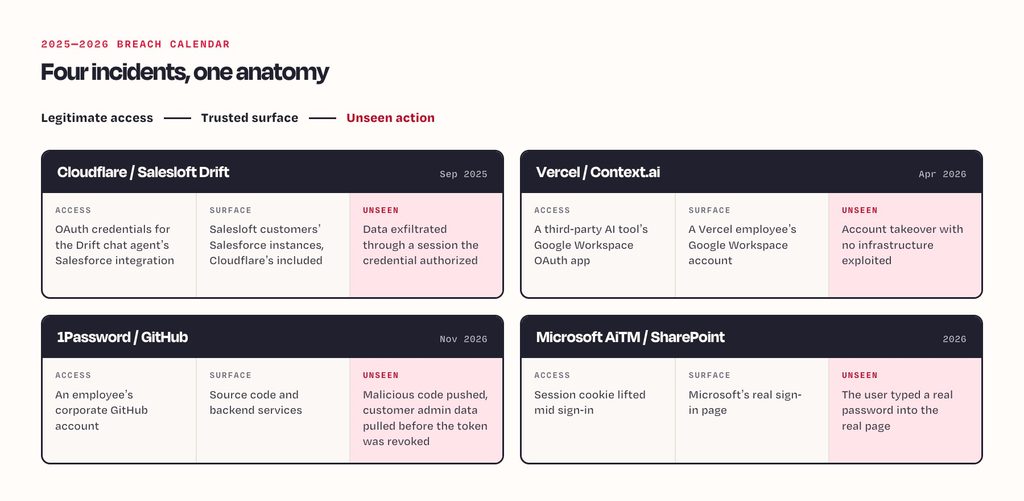
The specifics differ. The shape doesn’t.
The attacker uses access that was already granted — a browser cookie, an OAuth token, a session an identity provider has already blessed — and the controls at every other layer of the stack treat the resulting activity as legitimate. Because, from their vantage point, it is.
That is the point most security architectures aren’t yet built around.
Where perimeter and endpoint controls go blind
Perimeter controls assume the breach starts at the perimeter. EDR assumes the compromise starts with a process. DLP assumes the sensitive content moves as a file. None of those assumptions hold when the attacker is already inside a live session doing exactly what the legitimate user would do — typing into a prompt, pasting a document, authorizing an integration, exfiltrating through the same channel work moves through every hour of the day.
The firewall isn’t broken. It just can’t see above Layer 4. The EDR isn’t blind. It just doesn’t look inside a browser tab. The DLP isn’t wrong. It just inspects content at rest, not content in a prompt that’s being typed.
![The firewall isn't broken. The EDR isn't blind. Neither was built to look at this layer.]](https://redaccess.io/wp-content/uploads/2026/11/02-three-layers-1024x569.png)
The industry is converging on this quietly
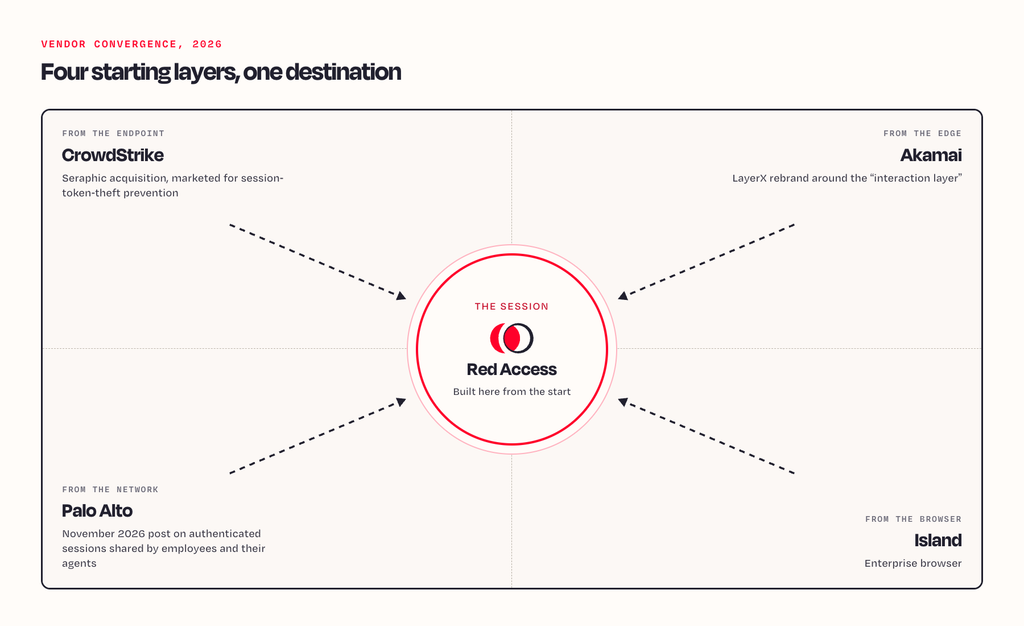
CrowdStrike’s Seraphic acquisition explicitly markets session-token-theft prevention. Akamai’s rebrand of LayerX uses the phrase “interaction layer.” Palo Alto’s November 2026 product post describes authenticated sessions shared by employees and their agents. Four years ago, “session” was a word used inside product documentation. In 2026 it’s a category the biggest vendors in security are reaching for — because the layer below it (the network) and the layer above it (the endpoint) have both admitted they can’t see where modern work happens.
Red Access made the bet earlier. The category is session security, and the mechanism is an in-flight engine delivered into every browser session: standard browsers, AI-native browsers, the embedded webviews inside Outlook, Slack, Teams, and ChatGPT Desktop, and the Copilot panes inside desktop Office.
What session security does differently
The engine governs the action, not the perimeter: prompt submission, upload, clipboard, download, cookie handling, token exfiltration patterns. When an adversary-in-the-middle page tries to redirect a legitimate Microsoft login and lift the resulting token, the engine inside the session sees it and blocks the move. When an employee pastes a customer list into an AI pane that the browser’s DLP doesn’t govern, the same policy fires. When a browser extension with cookie-read permission tries to exfiltrate a session cookie, the cookie it reads is already encrypted at rest inside the browser.
What makes this different operationally, rather than architecturally, is that there’s nothing to swap. No browser replacement. No extension rollout. No additional endpoint agent. The existing firewall, the existing EDR, the existing identity stack stay exactly where they are. Red Access adds the one layer they were never designed to see — the session itself — and feeds the events back into the SIEM the SOC already runs. Visibility becomes governance. Policy becomes enforcement.
Dor Zvi, Red Access’s CEO, tells a story that keeps getting more useful. A lawyer at a client firm was blocked from the AI tools the IT team had approved. He opened a browser, navigated to Pizza Hut’s website, found the support chatbot in the lower-right corner, and used it to help draft what he needed. No tool was installed. No policy was violated in any way the stack could detect. The session simply moved to a surface no one was watching.
That is the breach pattern now. Legitimate access. Trusted surface. Unseen action.
FAQ
What does “session security” actually mean?
Session security governs the live browser or webview session where modern work actually happens — the prompt as it’s typed, the file as it’s attached, the clipboard as it’s pasted, the cookie as it’s read. It sits between the perimeter controls that inspect traffic and the endpoint controls that inspect processes, at the layer that most of today’s breaches now pass through unseen.
How is this different from an enterprise browser?
An enterprise browser governs what happens inside its own browser window. Session security governs the session itself — inside any browser the employee opens, and inside the embedded webviews inside desktop apps like Outlook, Slack, Teams, and the Copilot panes in desktop Office. Nothing to install, nothing to replace, no training to roll out.
Does Red Access replace our existing firewall, EDR, or CASB?
No. Red Access was built to run alongside what’s already in place, adding the one layer those controls weren’t designed to inspect. Events flow into the SIEM the SOC already runs. The existing identity stack, firewall, and endpoint tools stay exactly where they are.
How does a session-level control catch OAuth abuse when the token itself is valid?
It can’t revoke a token the identity provider considers valid — that’s identity’s job. What it can do is govern what the session built on that token is allowed to do: block a file upload, redact a sensitive paste, prevent a cookie exfiltration pattern, log the action to the SIEM. The token stays valid. The attacker’s use of it doesn’t go unseen.
Does this work on BYOD or contractor devices the company doesn’t own?
Yes. Because there’s no endpoint agent, no extension to install, and no browser to replace, the control attaches to the work session wherever the session opens — on a managed Windows laptop, a contractor’s MacBook, or an unmanaged device the employee uses from home. The policy follows the work, not the hardware.
See every session your workforce is actually working inside. Request your free Red Access Insight Report →
Sources
Microsoft Learn. (2026, September 11). Enterprise management of WebView2. https://learn.microsoft.com/en-us/deployedge/webview2-enterprise#browser-policies-vs-webview2-policies
Vercel. (2026, April 19). Vercel April 2026 security incident. https://vercel.com/kb/bulletin/vercel-april-2026-security-incident
Cloudflare. (2025, September 2). The impact of the Salesloft Drift breach on Cloudflare and our customers. https://blog.cloudflare.com/response-to-salesloft-drift-incident/
1Password. (2026, November 25). Update on a security incident involving 1Password’s backend systems. https://1password.com/blog/update-on-nov-2026-security-incident
Shindler, D. (2026, March 16). The firewall isn’t blind — it just needs to see inside the session. The Hacker News. https://thehackernews.com/expert-insights/2026/03/the-firewall-isnt-blind-it-just-needs.html
Red Access. (2026, April 1). Block the prompt, not the work: The end of “Doctor No.” The Hacker News. https://thehackernews.com/2026/04/block-prompt-not-work-end-of-doctor-no.html