
Ask five vendors what “session security” means and you’ll get three different answers. Ask a CISO, and you’ll usually get a sixth: a general sense that something inside the browser and SaaS workflow isn’t being covered by the existing stack, but no clean label for it. This guide maps what the term means in 2026, who is using it, and what to look for in a solution built around it.
Key takeaways
- The term “session security” is in current use by at least three distinct vendor camps — post-authentication hijacking protection, in-session activity governance, and privileged session management — each meaning something structurally different.
- Forrester’s January 2026 analysis of the CrowdStrike/Seraphic acquisition reports that “over two-thirds of business users are doing the majority or all of their work within the browser today,” naming the shift that pushed session-layer protection onto the market’s agenda.
- Between November 2023 and July 2026, platform vendors acquired at least five browser or extension-security companies — Palo Alto/Talon, Zscaler/SquareX, Akamai/LayerX, CrowdStrike/Seraphic, Menlo/Votiro — while Island launched its own full SASE stack. Both directions converge on the session as the control point.
- Slicing the problem by risk (a dedicated AI security tool, a dedicated DLP tool) reproduces the same fragmentation as slicing it by surface. Either way, the gaps just move.
Session security refers to the discipline of applying visibility, policy enforcement, and real-time protection to what happens inside a live user session — across browsers, SaaS applications, AI tools, and embedded webviews inside desktop applications — rather than to the identity that opened the session or the network that carried its traffic. It answers a specific question: what is this user doing right now inside a sanctioned or unsanctioned application, and is it safe?
Three Current Meanings of “Session Security”
The phrase has not stabilized around a single definition. Three meanings coexist in the market today, each anchored by a different set of vendors and each answering a different security question.
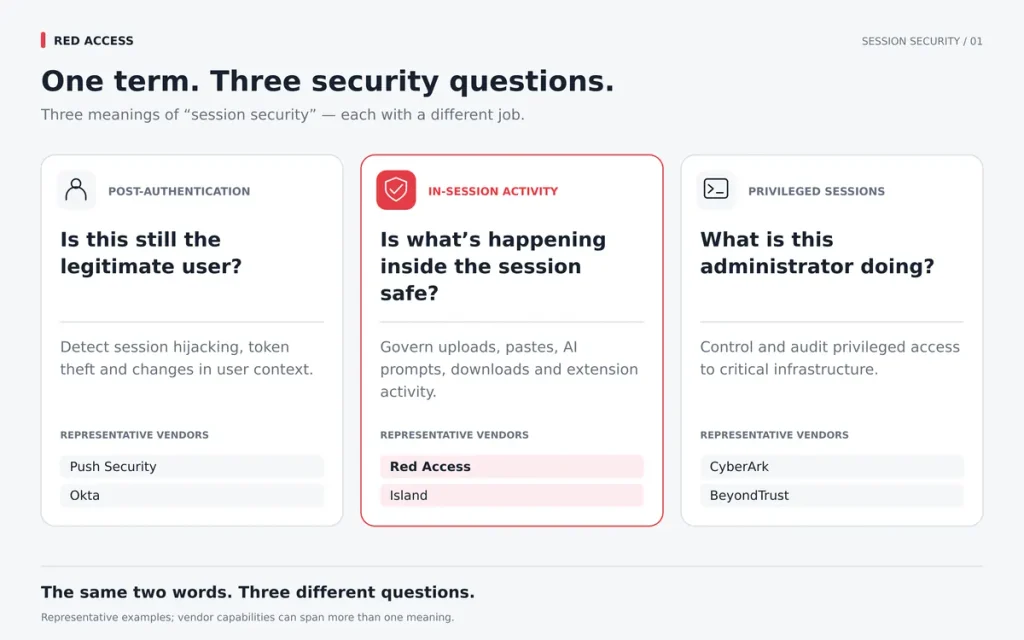
Meaning #1 — Post-authentication protection. The question is whether the authenticated user is still the one operating the session. Push Security’s current homepage leads with “Browser Security for the AI era” and covers session hijacking and token theft among its functions. Okta’s documentation defines its Session Protection feature as “a feature of the ITP risk engine that continuously monitors active sessions to detect and prevent session hijacking,” with step-up authentication and automated remediation. Microsoft’s Entra Token Protection fits the same camp. These controls assume the user authenticated correctly, and defend against theft of what authentication produced.
Meaning #2 — Securing activity inside the session. The question is what the user is doing within the session, not whether they’re still legitimate. This includes uploads, pastes, prompts into AI tools, file downloads, credential entry on unapproved domains, and the use of browser extensions with sensitive permissions. Red Access describes itself here, as do enterprise browser vendors like Island and Palo Alto’s Prisma Browser (though they reach the same scope through a different architectural choice). AI governance vendors like Harmonic Security cover a slice of this meaning scoped to AI activity specifically.
Meaning #3 — Privileged session management. The question is what an administrator is doing during a privileged connection to critical infrastructure — an SSH session, an RDP session, a database console. CyberArk, BeyondTrust and Delinea anchor this well-established category under the name Privileged Session Management (PSM). It governs sessions by privilege level, not by surface or activity type.
All three meanings are legitimate. They are not reducible to one another. The rest of this guide covers Meaning #2, because that’s the meaning the market is converging on in 2026 — and because the gap it addresses is the one most organizations have the least coverage for.
Why “Workspace” Has Outgrown the Tools Built to Secure It
The reason session-layer visibility has become a distinct problem is that the surface a security team needs to govern has multiplied faster than any category built to secure one surface at a time.
Take Claude as one example: an employee could be logged into Claude.ai in a browser, they could be using the Claude desktop app, they could have Claude embedded inside Microsoft apps they already use — just to name a few surfaces, often all on the same device at the same time. The same pattern repeats with ChatGPT, Copilot, Gemini, and the next assistant that hasn’t launched yet.
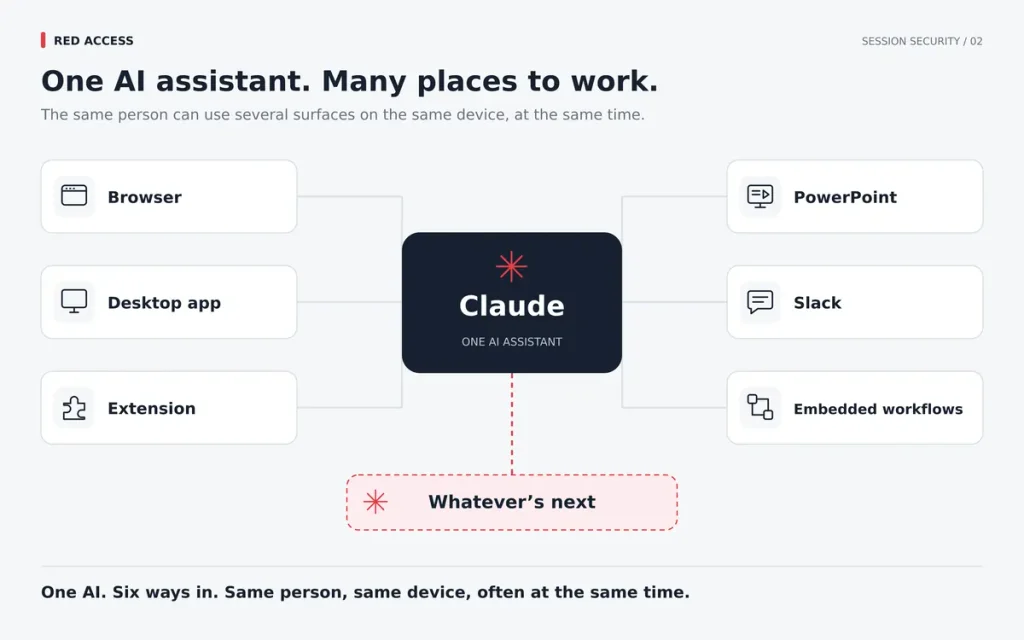
This is the Forrester data point on the ground. When analysts report that over two-thirds of business users do the majority or all of their work in the browser, they’re describing a real shift — but even that framing undercounts it. Much of what registers as “browser work” now runs inside embedded webviews in desktop applications that users don’t think of as browsers at all: Slack, Teams, Outlook, VS Code, Notion, Figma, Cursor, Claude Desktop. A rising share of the “endpoint” is a rendered web session inside a native container.
Each of those surfaces carries the same types of risk — a prompt sent to an AI tool, a file uploaded to a SaaS workspace, credentials typed into a lookalike domain, an extension with cookie-reading permissions — but each surface was historically governed by a different category of tool. Enterprise browser vendors cover sessions inside their own browser. AI governance vendors cover prompts inside AI tools. DLP vendors cover files leaving managed devices. The surface the user actually works on is often governed by three tools or by none.
Securing the Session by Risk, or by Surface — Either Way, the Gaps Just Move
Most organizations respond to this by adding another tool. If the exposure is AI, add an AI security tool. If the exposure is a new browser, add a browser security tool. If the exposure is an extension, add an extension governance tool. The result is coverage that looks comprehensive on a vendor map and is fragmented in practice.
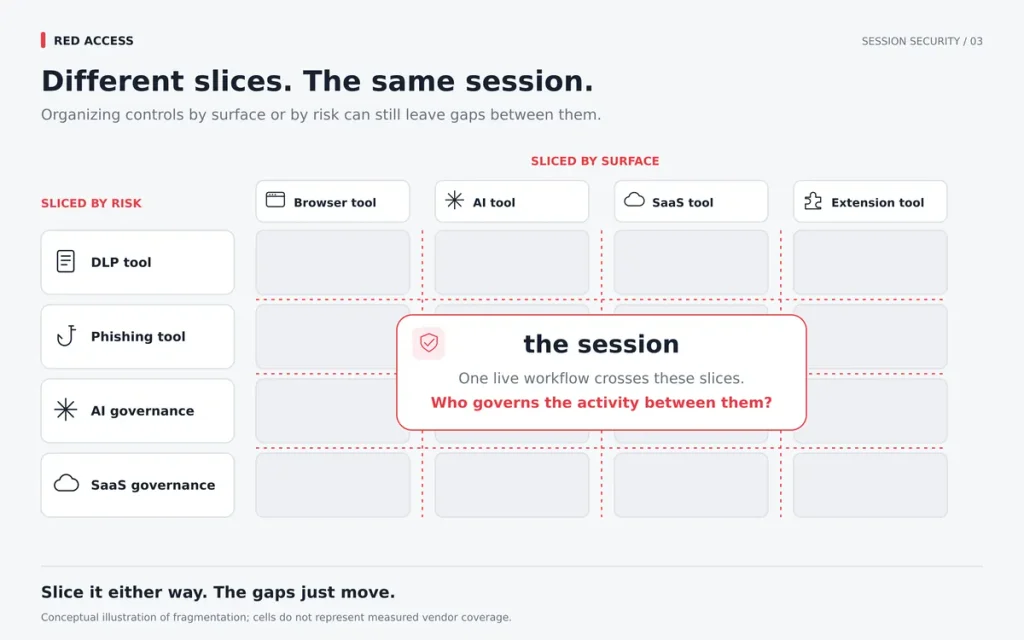
The fragmentation has two axes, not one. A team can slice its stack by surface — a dedicated browser tool, a dedicated AI tool, a dedicated SaaS tool, a dedicated extension tool — and end up with four vendors governing four slices of the same session. Or it can slice by risk — a dedicated DLP tool, a dedicated phishing tool, a dedicated AI governance tool — and end up with four vendors governing four risks across the same surfaces. Either slice produces the same pattern: a patchwork of controls that each reach toward the session from where their vendor started.
Going one direction — one tool that secures AI everywhere, for example — leaves the same surfaces exposed to everything that isn’t AI, pushing teams back to separate DLP, SaaS and extension controls on top. Going the other direction — one tool per surface — leaves each surface exposed to risks that cross between surfaces: a credential typed into a phishing site in the same browser where an employee just used an approved AI tool, a sensitive file dropped into a personal Slack workspace a minute after being downloaded from a corporate app. Either way, it just shifts the gaps rather than closing them.
Session security names the layer underneath all of these slices. It’s the common denominator that risk-sliced and surface-sliced stacks are each trying to reach.
The M&A Signal: How Vendors Are Converging on the Session Layer
The market has not yet settled on a term. But its deal flow since late 2023 tells one consistent story.
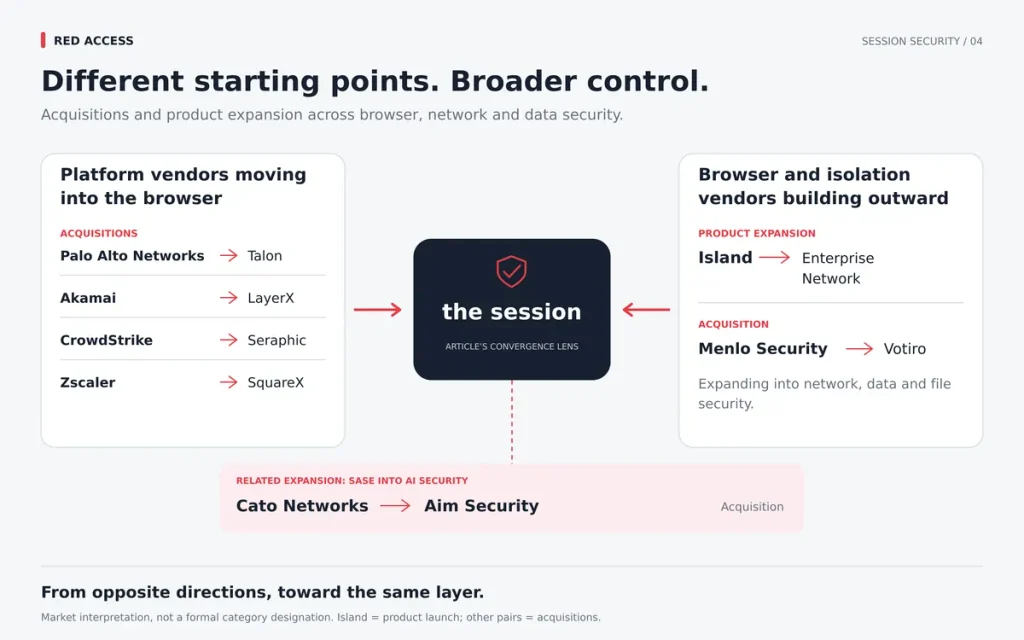
Platform vendors are moving into the browser. In November 2023, Palo Alto Networks announced the acquisition of Talon Cyber Security for $458.6M, with CPO Lee Klarich stating that “the average enterprise uses hundreds of SaaS and web applications, meaning that most work is now done primarily via the browser.” In February 2026, Zscaler acquired SquareX for $112.8M cash to “extend zero trust browser capabilities to secure any browser on any device.” Also in February 2026, CrowdStrike acquired Seraphic for roughly $327.5M, describing the goal as “a seamless security fabric that protects every interaction from the endpoint, through the browser session, and into the cloud.” In July 2026, Akamai completed its $205M acquisition of LayerX, framed as “uniting browser-native controls with Akamai’s Zero Trust and application security portfolio to secure the AI-era workforce.”
Browser and isolation vendors are moving outward. In February 2025, Menlo Security acquired Votiro to expand beyond browser isolation into data security across SaaS and collaboration tools. In March 2026, Island launched Island Enterprise Network — described in their own announcement as delivering “the complete SASE stack on a single enterprise control plane.” In September 2025, Cato Networks acquired Aim Security to add AI security to its SASE platform.
The two lists tell the same story from opposite sides. Network and endpoint platform vendors are buying their way into the browser session. Browser and isolation vendors are building their way out into network and data. Both directions converge on the same layer: what happens inside the live user session, across whichever surface the user is working on.
Each of these acquisitions is a legitimate answer to part of the problem. None of them, on their own, delivers a solution — most require customers to adopt an entire suite or replace what they already run. But the fact that this many vendors, from this many starting points, are reorganizing around the same layer within 36 months is the strongest available signal that the layer deserves a name.
What Session Security Actually Covers in Practice
In practice, a session-layer control governs the specific behaviors that happen inside a live session, independent of which browser, SaaS tool, AI tool, or embedded application the session runs in. That includes credential entry on lookalike or unapproved domains, file uploads and downloads, clipboard content moving between tabs or applications, prompts submitted to AI tools, use of browser extensions that hold sensitive permissions, and access to sanctioned SaaS from personal or unsanctioned accounts.
The scope is defined by the session, not by the surface. A policy that blocks source code from being pasted into Claude applies the same way whether the user is on Claude.ai in a browser, in the Claude desktop app, or in Claude embedded inside Microsoft apps. A policy that restricts downloads of customer data applies whether the download target is Chrome, a Slack message, or a WhatsApp Desktop conversation.
The scope explicitly includes surfaces that don’t yet exist. The next AI assistant, the next browser fork, the next embedded webview inside a desktop application will each produce new sessions that carry the same kinds of risk. A session-layer control that depends on enumerating supported surfaces loses the thread the moment a new one lands.
How Session Security Differs From Adjacent Categories
Session security sits in a space adjacent to several established categories. It overlaps with each without being equivalent to any.
Security Service Edge (SSE). The July 2026 Gartner SSE Magic Quadrant lists Netskope, Palo Alto Networks and Zscaler as Leaders. SSE governs the traffic path between the user and the application, with capabilities for web filtering, CASB, DLP in transit, and ZTNA. Session security governs what happens inside the session once the traffic has arrived. The two are complementary — several SSE vendors have acquired browser security capabilities specifically to extend their scope into the session.
Secure Enterprise Browsers (SEB). Gartner’s April 2025 prediction holds that 25% of organizations will use a Secure Enterprise Browser by 2028. The February 2026 Market Guide maintains that figure. SEBs deliver session-layer control by replacing or supplementing the browser itself. Session security covers the same scope without requiring that replacement.
DLP and CASB. Both categories touch the session, but from the data direction (DLP) or the SaaS access direction (CASB). Session security operates on the session itself, which is why risk-sliced stacks that include DLP and CASB still miss activity that falls between the two.
Workspace Security. Gartner uses this broader term to describe the overall market for protecting enterprise workflows across endpoints, browsers, SaaS, and collaboration tools. It’s a large category with many entrants, each covering a different portion. Red Access and many other vendors fit inside it; only the largest platform players cover a substantial share of it. Session security is one lens on the Workspace Security problem — the lens focused on what happens inside the live session, across the surfaces where modern work actually happens.
Privileged Access Management (PAM). Governs administrator sessions to sensitive infrastructure. Separate meaning, separate market, separate vendors (CyberArk, BeyondTrust, Delinea).
Remote Browser Isolation (RBI). Isolates risky web activity by rendering it remotely. A legitimate control for certain use cases, now typically delivered as a capability within broader SSE or secure browsing platforms rather than as a standalone category.
What to Look for in a Session Security Solution
A session security solution should answer seven questions clearly, and should answer them without requiring a buyer to assemble the answer from multiple products.
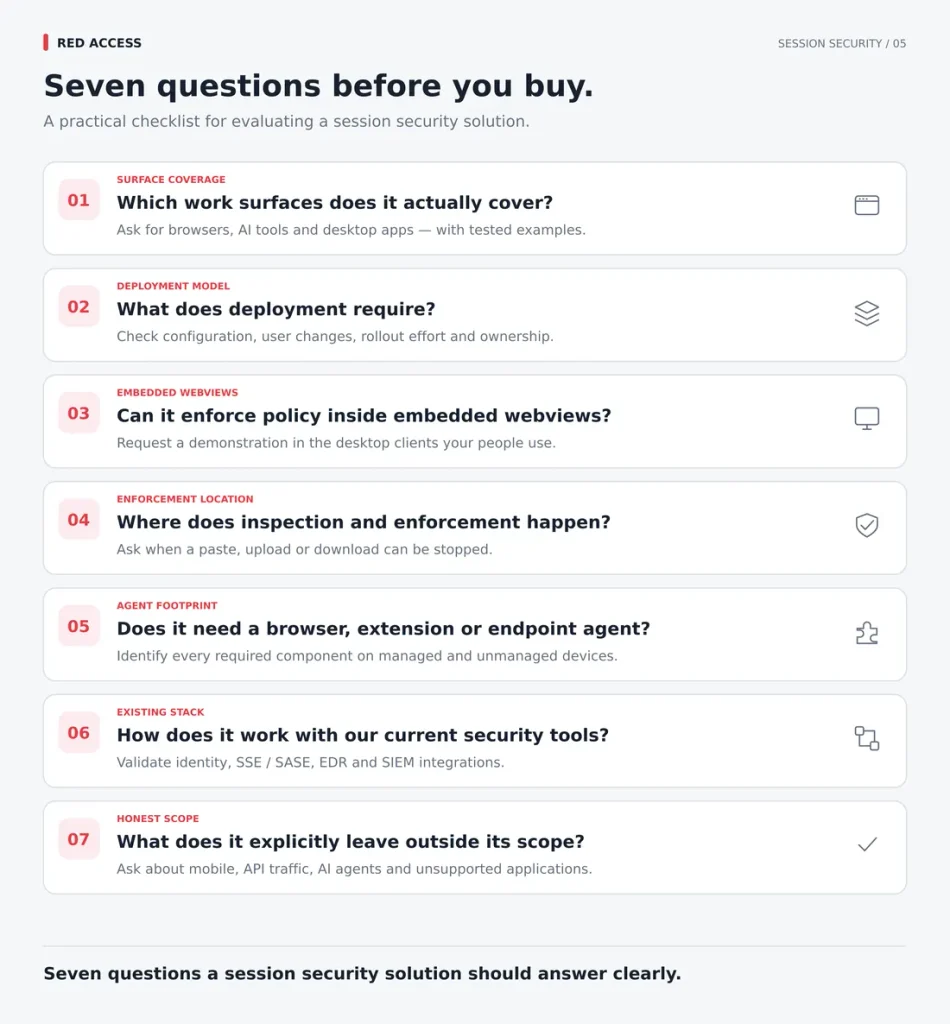
What surfaces does it cover? Not just the browsers, but the embedded webviews inside desktop applications where a growing share of enterprise work runs. A solution that governs Chrome and Edge but not Claude Desktop, Slack, or Teams is covering the surface the user used to work on.
Where does enforcement happen? Inside the session, locally, before data leaves the user’s environment — or in the network, after the user’s action has already been taken? Enforcement that happens in-session can block a specific paste or upload. Enforcement that happens in the network can block a destination.
What’s the deployment model? Does the solution require users to install a new browser, run a new extension, or accept another endpoint agent? Each of those has a real operational cost — a managed browser rollout is a multi-quarter project, an extension rollout competes with every other security extension already in the browser, and an agent rollout competes with EDR for endpoint resources.
How does it handle unmanaged devices? Contractors, BYOD, personal laptops accessing corporate SaaS. A session-layer control that only works on managed devices has given up on a growing share of the surface.
Does it integrate with the existing stack? SSE, SASE, EDR, identity, SIEM. Session security should extend what a security team already runs, not require replacement of any of it.
Is its scope honestly described? Mobile, API-to-API traffic, MCP-layer agent activity — these may or may not be covered. A solution that implies coverage of everything is signaling positioning rather than architecture. A solution that names its limits clearly is signaling the opposite.
Does it treat future surfaces as in-scope? The next AI tool, the next embedded webview, the next browser fork. A session-layer control that requires per-surface engineering work for each new entrant will fall behind within quarters.
Session Security and Red Access
Red Access is a session-layer security platform covering browsers, SaaS applications, AI tools, and embedded webviews inside desktop applications. It governs credential entry, uploads and downloads, prompts to AI tools, clipboard movement, browser extension activity, and SaaS account use across the surfaces where that activity happens. No browser replacement, no extension rollout, no additional endpoint agent. [VERIFY: current public user count] Over half a million users in production, across manufacturing, financial services, retail, legal, healthcare, and government.
It sits alongside SSE, EDR, and identity controls rather than replacing any of them. Its scope is the session. Mobile is not covered. API-to-API traffic is not covered. ZTNA is not covered — Red Access is not a VPN replacement.
If you’re mapping the session-layer gaps in your own stack, see what Red Access surfaces across your fleet in a one-week assessment →
FAQs
Is session security the same as session management?
No. Session management is the application-security discipline of designing, issuing, rotating, and terminating session tokens securely — the subject of the OWASP Session Management Cheat Sheet. Session security, in the meaning this guide uses, is the broader enterprise security discipline of governing what happens inside a live user session once it’s open. The two are complementary. Session management keeps the token itself safe. Session security governs what the holder of the token does with it.
How is session security different from an enterprise browser?
An enterprise browser delivers session-layer control by replacing the browser the user works in. It’s an effective architecture, with a significant operational cost — a managed browser is a project to deploy, and it governs sessions only inside itself. A session-layer control that operates without browser replacement delivers the same scope of control across the browsers and embedded webviews the user already uses.
Does Red Access compete with Zscaler, Netskope, or other SSE vendors?
No. SSE and session security are complementary layers. SSE governs the traffic path between the user and the application. Session security governs what happens inside the session once the traffic has arrived. Red Access works alongside SSE deployments, not instead of them. Several SSE vendors have themselves acquired browser security companies specifically to extend their scope into the session.
Is “session security” a formal analyst category?
Not yet, under that exact name. Gartner’s February 2026 Market Guide for Secure Enterprise Browsers covers a large portion of the same scope. Forrester’s January 2026 analysis of the CrowdStrike/Seraphic acquisition describes the convergence qualitatively. Neither analyst has published a Magic Quadrant, Wave, or Radar titled “Session Security” as of late 2026. The deal flow suggests the category is forming faster than analyst coverage is naming it.
What about mobile sessions?
Red Access does not cover mobile sessions as part of its core product. Session security as a discipline applies to mobile in principle, but the architectures that govern mobile sessions — mobile device management, mobile application management, mobile browser controls — are different from the ones that govern desktop and laptop sessions. Any solution claiming to cover both should be examined carefully for what it actually enforces on mobile.
How does session security relate to AI security?
AI security is a slice of session security defined by the type of risk (AI prompts, model use, data sent to AI tools) rather than by the layer being secured. Dedicated AI security tools cover that slice well, across the surfaces they support. They don’t cover non-AI risks on the same surfaces — credentials typed into a phishing site, files dropped into unapproved SaaS, extensions with sensitive permissions. A session-layer control covers the AI slice as one risk among several, across the surfaces where the session happens.