Infostealer malware rarely breaks into the company. It gets installed on a home PC, a contractor laptop or a gaming rig that also holds a work login, and it ships every saved password and session cookie to a log someone else will buy. This guide covers how stealers get in, what they take, and how to prevent and contain them.
Key takeaways about infostealer malware
- Takedowns slow the families without ending the trade. Microsoft’s Digital Crimes Unit seized or blocked about 2,300 Lumma domains in May 2025, and Trend Micro saw its infrastructure ramping up again within weeks.
- Verizon’s 2025 DBIR found 46% of stealer-infected systems holding corporate logins were unmanaged, so infostealer prevention that stops at the managed fleet misses nearly half the exposure.
- A stolen session cookie represents a login that already passed MFA. Rotating the password limits future access, but only revoking active sessions ends the one already in an attacker’s hands.
- Infostealer browser extensions skip the download entirely. Cyberhaven’s hijacked Chrome extension could exfiltrate cookies and authenticated sessions for about 25 hours over Christmas 2024 before it was pulled.
The path from a personal download to a corporate breach usually runs through the browser, because the browser session is the new security perimeter for SaaS-heavy companies. A stealer doesn’t need your network. It needs one device where someone signed in to work. One is enough.
What Is Infostealer Malware?
Infostealer malware is commodity software that collects credentials from an infected computer and sends them to its operator as a single package called a stealer log. It targets what the device already stores: not the network, not the server, but the browser profile, where saved passwords, session cookies, autofill entries and crypto wallets sit on disk for the signed-in user. Many run as smash-and-grab tools that collect everything in one pass. Europol notes that many victims never knew they were infected.
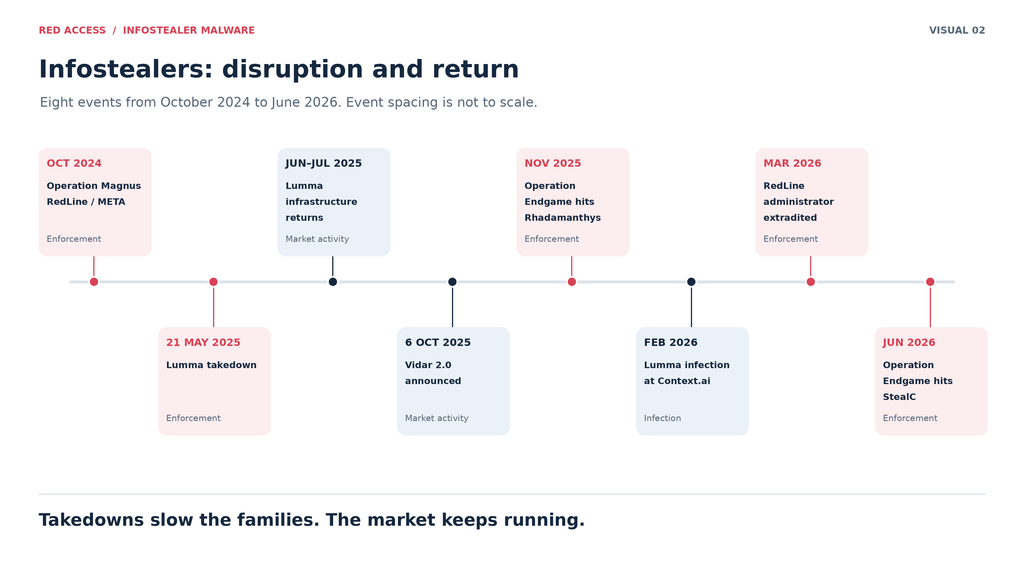
Stealers are sold as a service to paying affiliates, and the logs are resold to whoever wants a way in. Microsoft’s Digital Crimes Unit called Lumma the “favored info-stealing malware” of hundreds of criminal crews when it announced action against the operation on May 21, 2025, after counting more than 394,000 infected Windows computers between March 16 and May 16. Two months later, Trend Micro reported Lumma’s infrastructure “ramping up again within weeks.” A takedown removes servers. It doesn’t remove the market.
| Family | Status as of October 2026 | Last enforcement action | Source |
| Lumma (LummaC2) | Active at reduced scale. Rebuilt within weeks, declined after its alleged operators were doxxed from August to October 2025, 10% of the stealer activity Microsoft Defender Experts saw from July 2025 to June 2026 | May 2025: about 2,300 domains seized or blocked by Microsoft’s DCU, alongside DOJ, Europol EC3 and Japan’s JC3 action | Microsoft, Trend Micro |
| RedLine / META | Infrastructure disrupted; prosecutions ongoing | October 2024, Operation Magnus; alleged administrator extradited to the US in March 2026 | U.S. Department of Justice |
| Rhadamanthys | Disrupted; no confirmed return in the reporting reviewed | November 2025, Operation Endgame: 1,025+ servers and 20 domains (with VenomRAT and Elysium) | Europol |
| Vidar 2.0 | Active. Rewritten in C, multithreaded, announced October 6, 2025 as Lumma declined | None announced against version 2.0 | Trend Micro |
| StealC | Disrupted. Microsoft linked StealC and its Amadey loader to more than 140,000 infected computers in the first two weeks of May 2026 | June 2026, Operation Endgame: 326 servers and 142 domains actioned in a wider strike; 27 million stolen credentials recovered | Europol |
| Atomic (AMOS), macOS | Active. Half of the stealer activity Microsoft Defender Experts saw from July 2025 to June 2026, and the most popular Mac stealer Red Canary observed in 2025 | None announced | Microsoft, Red Canary |
How Infostealers Get In: Fake Downloads, Cracked Software and Malicious Extensions
Most infections start with something the user chose to run. A crack. A cheat. A free tool. Microsoft Threat Intelligence describes cracked or pirated applications “bundled with Lumma binaries and distributed through file-sharing platforms.” CISA and the FBI add spoofed media players and utilities, plus the fake CAPTCHA (ClickFix) that tells users to paste a command into the Windows Run box. Trend Micro lists GitHub abuse and social media posts. IBM X-Force counted an 84% increase in emails delivering infostealers in 2024 over 2023. Search ads and hacked sites are a separate route, covered in the drive-by download guide.
Look at where those downloads land. In Snowflake-related cases, Mandiant found the initial infection “occurred on contractor systems that were also used for personal activities, including gaming and downloads of pirated software.” In February 2026, Lumma infected a Context.ai employee whose browser history showed downloads of Roblox “auto-farm” scripts, a common Lumma lure. Hudson Rock assessed that infection as the likely origin of the April 2026 Vercel breach, which Vercel confirmed began with a compromise of Context.ai. Call it the crossover device: one machine, one user profile, holding personal downloads and corporate sessions. Corporate EDR often isn’t on it.
Macs aren’t exempt. Red Canary’s threat detection report names Atomic Stealer the most popular Mac stealer it observed in 2025, with Poseidon rebranded as Odyssey and back in circulation as the second most popular. The third delivery path doesn’t involve a download at all. It’s a browser extension, covered below.
What Infostealers Steal From the Browser: Passwords, Cookies and Session Tokens
Microsoft’s analysis of Lumma is specific: it “extracts saved passwords, session cookies, and autofill data from Chromium (including Edge), Mozilla, and Gecko-based browsers,” then searches for wallet files and wallet extensions. The CISA advisory adds personally identifiable information, financial credentials and MFA details. Browser credential theft is the core of the job, but desktop apps that keep their own tokens are in scope too.
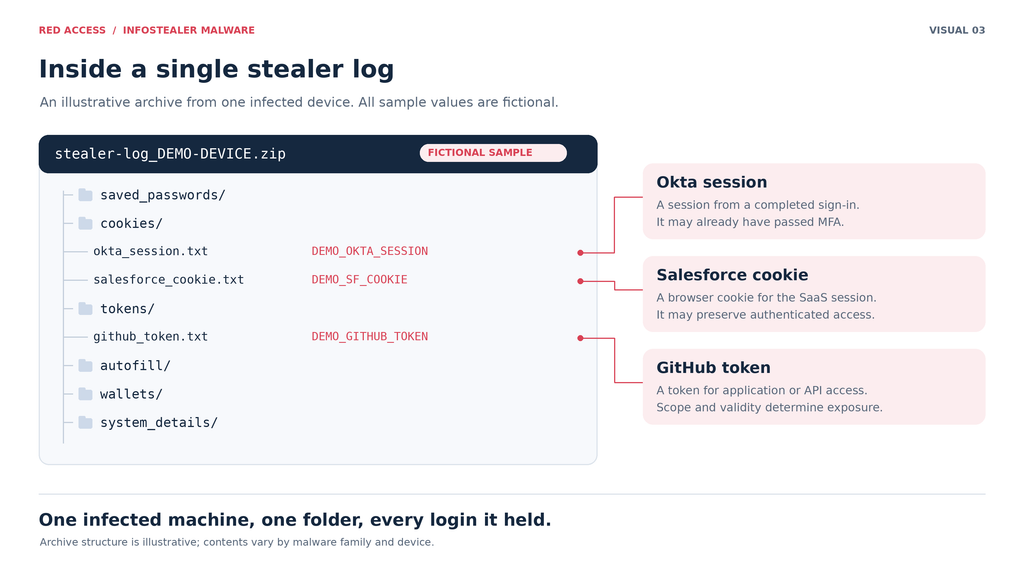
The enterprise value is in the detail. The Context.ai log, per Hudson Rock, held Google Workspace credentials plus keys and logins for Supabase, Datadog and Authkit. Picture the same log for one of your staff: an Okta session, a Salesforce cookie, a GitHub token, all listed under a URL that tells the buyer where each one works. No phishing page required. The Verizon 2026 DBIR traces where that leads. Only 27% of ransomware victims had no associated infostealer or credential leak during the year, and among those that did, half saw the event within 95 days before the attack.
Logs also age well. Mandiant found that most credentials used in the 2024 Snowflake campaign came from historical infostealer infections, some dating to 2020, and roughly 165 potentially exposed customers were notified. The affected accounts had no MFA, so a username and password were enough. An infection you cleaned up years ago can still be someone’s login today.
How Infostealers Steal Browser Cookies (and Why MFA Doesn’t Help Afterward)
How infostealers steal browser cookies comes down to one design decision. Browsers keep cookies and saved passwords in local database files inside the user’s profile, encrypted so other accounts on the machine can’t read them. On Windows, Chromium browsers historically protected the key with DPAPI, the operating system’s per-user encryption service. Any program running as the signed-in user could ask for the same decryption the browser does. Elastic Security Labs states it directly: malware “running in the targeted user’s context could decrypt these cookies.” That is exactly where a stealer runs after someone double-clicks it. No exploit needed.
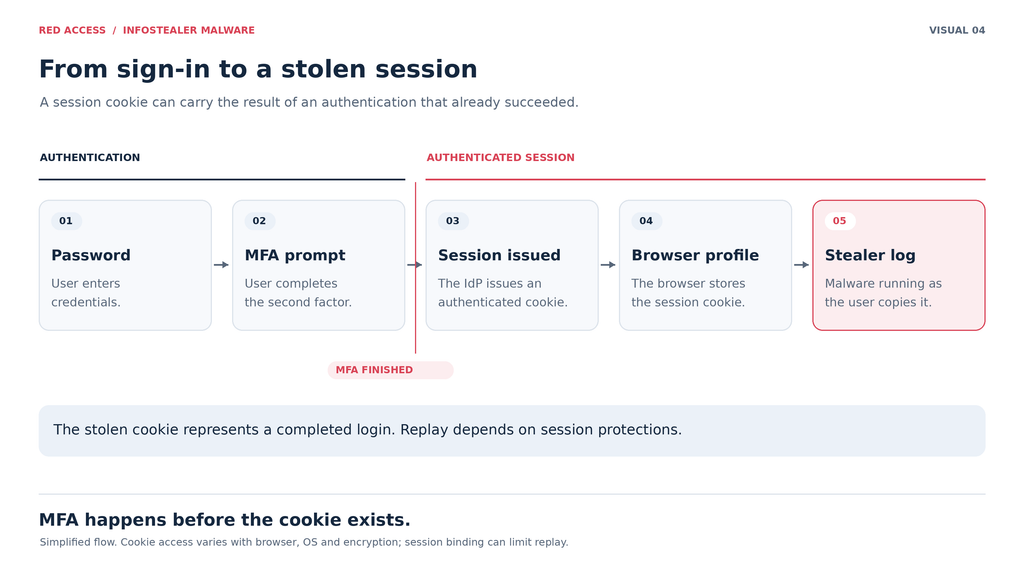
Google’s response, App-Bound Encryption in Chrome 127 in July 2024, ties the key to Chrome itself through a privileged service. Stealers adapted within months, and Vidar 2.0 launched claiming a bypass of its own. The details of that arms race matter less than the outcome. The stealer still leaves with cookies. They still work.
A session cookie is what the identity provider issues after the password and the MFA prompt both succeed. It stands for a finished login. MFA protects the sign-in. It doesn’t protect what the sign-in produced. How attackers replay those cookies, and which controls interrupt the replay, is the subject of how attackers get around MFA.
Infostealer Browser Extensions: The Threat Hiding in Plain Sight
Some stealers never ship an executable. They arrive as an extension, or as an update to one the user already trusts. An extension with permission to read a page can read it while the session is live, and some ask for cookie access outright. That is how a single malicious extension can do a stealer’s job with nothing for an endpoint scanner to quarantine. Same haul, different door.
Cyberhaven’s disclosure is the clearest record. On December 24, 2024, a phishing attack compromised an employee’s access to the Chrome Web Store, and the attacker published version 24.10.4 of the company’s extension. It was live from 1:32 AM UTC on December 25 to 2:50 AM UTC on December 26, and on browsers that auto-updated it “could have exfiltrated cookies and authenticated sessions for certain targeted websites,” mainly social media advertising and AI platforms. Cyberhaven’s team removed it within 60 minutes of detection. Fast, by any standard. Darktrace counts more than 30 other extensions hit in the same campaign.
The older pattern is a stealer built as an extension from day one. Rilide, disclosed by Trustwave SpiderLabs in April 2023, posed as a Google Drive extension in Chromium browsers, tracked visited URLs against a target list, captured screenshots and used forged dialogs to collect 2FA codes. Think of the “productivity” add-on that works as advertised until one update changes what it collects. Governing that inventory is the job of browser extension security; review and supply-chain mechanics are a separate subject.
Infostealer Prevention: A Layered Checklist for Security Teams
EDR catches infostealers on the machines it runs on, and that is where the first layer belongs. The problem is reach. Verizon’s 2025 DBIR found that 46% of systems compromised with an infostealer that had possible corporate login data were non-managed devices. Infostealer prevention isn’t only an endpoint detection problem. It’s a session problem, because the cookie is what gets sold.
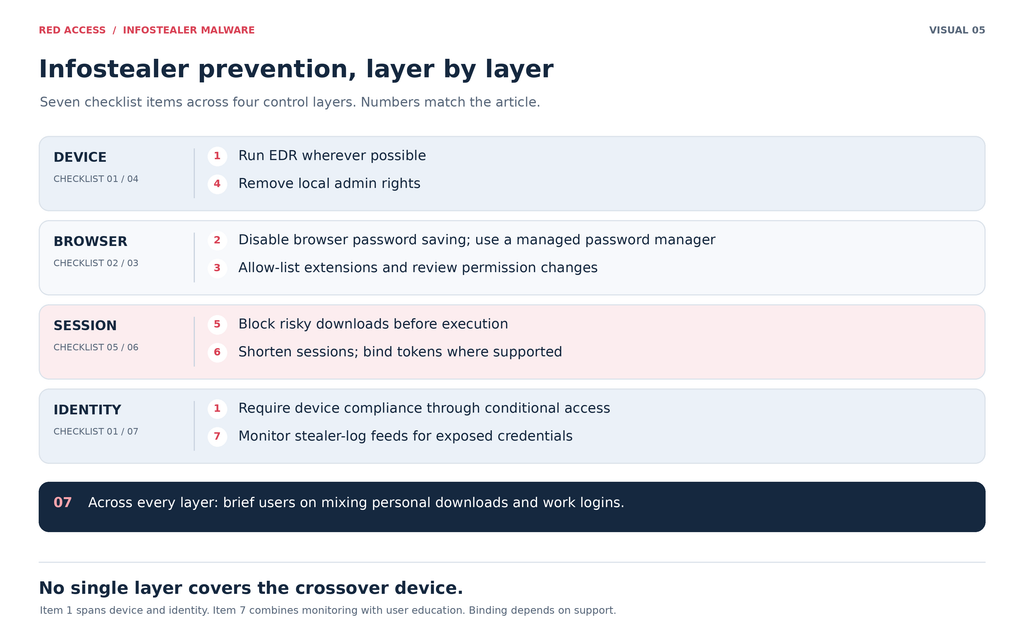
- Run EDR everywhere you can, and make access depend on it. Conditional access keeps sensitive apps off devices that fail a compliance check.
- Get passwords out of the browser. Disable built-in password saving through browser policy and move staff to a managed password manager. It shrinks the haul, though it won’t stop cookie theft.
- Allow-list extensions. Block installs by default, approve by extension ID, and review updates that add permissions.
- Remove local admin rights. Stealers run fine as a standard user, so this won’t stop them outright. It blocks installers that need elevation, and it keeps intact the assumption behind Chrome’s App-Bound Encryption, which was built to resist malware running without admin rights.
- Block risky downloads at the session. Executables and archives from cracked-software, game-cheat and file-sharing sites don’t belong on a device that holds work sessions.
- Shorten and bind sessions. Cut token lifetimes on high-value SaaS and use token binding where your IdP and browser support it, so a copied cookie fails elsewhere.
- Watch stealer-log feeds and brief users on the crossover device. Hudson Rock says it held the Context.ai credentials more than a month before the Vercel breach went public. Tell staff plainly that a game cheat on a machine with work logins puts company sessions up for sale.
Items 3, 5 and 6 are where Red Access fits. It applies policy inside the browser session on managed and unmanaged devices alike, so malicious files can be identified and blocked before they execute and unapproved extensions can be blocked, and its phishing and token theft protection detects and blocks credential entry on lookalike or unapproved domains and flags session reuse that originates outside the authenticated session’s expected context. It isn’t an endpoint malware scanner, and it doesn’t replace items 1 through 4.
Limiting the Damage When a Device Is Already Infected
Assume the stealer finished before anyone noticed, and start with sessions instead of passwords. Revoke every active session and refresh token for the user at the IdP and in each high-value SaaS app the log touched. Then rotate passwords, API keys and secrets. Order matters. Bitwarden’s response checklist is blunt about the order: ‘credential rotation alone does not close the window on an active session.”
Next, scope the exposure. Query stealer-log intelligence for the user, the device and your domains, and review sign-ins and data access back to the earliest plausible infection date. A managed laptop gets isolated and reimaged. A personal one can’t be. The practical move is to cut the crossover device off from corporate sessions until it’s clean, which is why unmanaged BYOD devices need policy at the session rather than trust in the endpoint.
Be clear about the limits. Once a stealer runs on an unmanaged device, a session-layer product, Red Access included, doesn’t remove it or stop it reading local browser stores. EDR does the removing where it’s installed; revocation and session invalidation do the containing. Session-layer control narrows what attackers do with stolen sessions and whether the next download or extension gets through.
If you’re working out how much of your stealer exposure sits on devices you don’t manage, a 7-day session-layer assessment surfaces every active extension across your fleet, which ones hold permissions to sensitive session data, and what actually leaves the session on each device — the credentials typed, the files uploaded, and the data pasted into AI tools — with no browser replacement, no extension rollout, and no additional endpoint agent. Request a Red Access assessment →
FAQs
Can antivirus detect infostealers?
Often, on the machines where it runs. Signature and behavior engines catch many commodity stealers, and EDR adds detection for the credential-access steps they take. The gap is coverage, not capability. A personal laptop or contractor machine without your agent never reports the detection, and a log exfiltrated before any alert fires is already on its way to a buyer.
Does changing my password stop an infostealer?
Not on its own. A new password blocks future logins that use the old one, but session cookies already in the log can keep working until the session expires or is revoked. Revoke active sessions first, then rotate credentials, and clean or wipe the infected device so the stealer doesn’t simply collect the new password the next time you type it.
Are Macs affected by infostealers?
Yes. Microsoft’s 2026 Digital Defense Report puts Atomic macOS Stealer at half of the infostealer activity its Defender Experts customers saw from July 2025 to June 2026, and Red Canary ranks Odyssey (the rebranded Poseidon) and MacSync behind Atomic. They pursue the same prize as Windows families. Mac fleets that skip EDR on the assumption that stealers are a Windows problem are carrying that exposure unmonitored.
How do I know if my company’s credentials are in stealer logs?
Subscribe to a stealer-log intelligence source that indexes logs by email domain and login URL, and query your domains on a schedule rather than after an incident. Expect regular hits. The Verizon 2026 DBIR found that larger companies faced around 20 credential leak events over the year, and small ones a median of seven.
Do password managers protect against infostealers?
Partly. A password manager keeps credentials out of the browser’s built-in store, which stealers such as Lumma raid by default. It can’t protect the session cookie the browser holds after you sign in, and malware with full control of the device may still capture what you type or unlock. Pair it with short session lifetimes and fast revocation.
Is Lumma still active?
Yes, at lower volume than at its peak. Trend Micro saw Lumma’s infrastructure return within weeks of the May 2025 takedown, and activity fell after its alleged operators were doxxed later that year. Lumma still accounted for 10% of the stealer activity Microsoft Defender Experts saw from July 2025 to June 2026. One expected successor, StealC, was itself disrupted in June 2026.